
Note: Some of the questions shown below are in reference to previous models of Jandel’s four point probe electronics such as the RM2 and the RM3 Test Units, however, the information in the responses can be helpful. The current Jandel four point probe measurement electronics read-out in either mV, ohms-per-square, or ohms-cm without requiring the of the included USB interface application software, and will auto-range to determine the best choice of input current. Jandel four point probe measurement electronics have many features to simplify the four point probe measurement.
Q1. I understand that the RM3 Test Unit can read out directly in ohms-per-square for use when measuring thin films (sheet resistance), but how do I measure thick materials that are measured in ohms-cm (volume resistivity)? What current level do I select for a particular material?
A. The RM3 Test Unit included PC software which would calculate sheet resistance. The newer Jandel four point probe measurement electronics can display either mV, ohms-per-square, or ohms-cm on the display or by using the software. However, if you have an older system and you want to calculate volume resistivity values without using software, you will want to use an input current which will simplify the math:
The formula is 2 x pi x s x V/I where s is the spacing between each of the needles in cm. If you use a probe with tip spacing of 1.591mm (~same as 62.6 mils), it makes the math easier since 0.1591 is 1/(2 x pi). Therefore we would have: Resistivity = V/I
This means that if 1mA current is used, then the measured voltage value (in millivolts) = the resistivity of the sample in ohms-cm.
If measuring on the ‘High’ range it may be that the voltage will be too high to measure. In this case try 100uA and the mV result would need to be multiplying by 10. If the voltage value is quite low (maybe 9mV or so), increase the current to 10mA and then the mV result could be divided by 10 to give the resistivity (higher currents can sometimes offer more stable results).
Q2. Could you please give more information on how the Jandel four point probe measurement electronics calculate resistivity? Is it merely an implementation of one of the equations in the 4-point probe manuals depending on the needle arrrangement used and whether it is a thin film or bulk material?
A. When measuring sheet resistance, which calculations can be used for most homogeneous silicon wafers depending on the thickness, the Jandel four point probe measurement electronics forces a constant current across the outer two probes and then the resulting voltage is read across the inner two probes. If a constant current of 4.5324 milliamps is used, then the resulting voltage in millivolts is numerically equivalent to the sheet resistance value in ohms-per-square. This assumes that 4.5324mA is a suitable input current, however, it is not suitable for all materials.
Checking for good correlation between the voltage values measured when the current is forced forwards and then reversed is the standard way to validate a measurement and check whether the input current is sufficient. Some materials require a greater or lesser current level and an appropriate adjustment must be made to the voltage read so that the value will be correct in ohms-per-square.
For example, if using 10 times the current, then the voltage would be 10 times higher and it would need to be divided by 10 to be the correct value in ohms-per-square. If calculating bulk resistivity from a sheet resistance measurement, the value in ohms-per-square can be multiplied times the thickness of the material in centimeters to arrive at the bulk (or volume) resistivity value which is expressed in “ohms-cm”. For example, if measuring a thin film that was 100 microns thick, and the sheet resistance value was 20 ohms-per-square, then the volume resistivity for that material would be 0.2 ohms-cm (0.01 x 20).
The Jandel four point probe measurement electronics include PC software which prompts for information as to whether a bulk material or thin film is being measured, and then calculates the volume resistivity or sheet resistance. The current Jandel four point probe measurement electronics can read out directly in ohms-per-square, or millivolts, and the superior models can also read-out directly in ohms-cm without the need to use the software.
Materials that are thicker than 62.5% of the spacing between two adjacent probes must be measured as a bulk sample since sheet resistance would require more than 1% correction. Thick samples are measured in “bulk resistivity”, also called “volume resistivity”, which is expressed in ohms-cm, and which takes into account the probe tip spacing as part of the calculation. Bulk materials with a thickness of less than 5 times one tip spacing must be corrected for sample size.
Jandel measurement electronics software applies the basic four point probe equations giving it the ability to calculate sheet resistance or bulk resistivity by taking into account some user inputs such as material thickness and probe tip spacing.
The following Q&A’s refer to questions asked about the now discontinued RM2 Test Unit, however, some of the information applies to Jandel’s current equipment as well.
Q3. Is this statement correct?….By setting the current to 453 microamps, I’m putting that amount of current through two of the probe tips. The other 2 tips are then reading a voltage value which is the value that shows up in the RM2 output unit as a mV reading?
A. That is correct – on our equipment the outer two probes are used for current, and the inner two are used for voltage measurement. We tend to set the RM2 (if the samples are suitable) to deliver a current of 4.5324 milliamps (453.24 on the x10 setting). This means that the measured voltage drop displayed in millivolts is numerically equal to the sheet resistance in ohms per square.
Q4. If I used a different current input, I would then need to calculate sheet resistance from the formula, right?
A. Correct.
Q5. Compliance is set at 25V currently. How do you determine what to set this at?
A. Generally it would be a difficult sample if more than 25V was required, however, the current desktop model as well as the discontinued RM2, RM3, and RM3-AR Test Unit all have/had 40 volts available to drive the measurement. A number of systems available on the market have a four wire connection and are primarily DVMs with a compliance voltage of around 6V which often is not sufficient. On occasion if a current cannot be driven through the sample the red light under “compliance voltage” on the RM2 will glow. It is possible that a higher compliance voltage (i.e. moving the knob to 50V) will help. There is no problem with leaving the compliance voltage set at 50V at all times.
Q6. On the Jandel RM2 Test Unit, what is the “Filter” feature? If this improves the reading, when would you ever want to shut it off?
A. The filter can slow readings where a small current is required. At times it is absolutely essential, however with some samples which give stable readings speed of readings can be improved by not using the filter.
Q7. On the Jandel RM2 Test Unit, regarding the “200mV / 2000mV” buttons – Does this change the reading range that I could possibly see as an output voltage or is there another purpose for the buttons?
A. It merely changes the range so that an optimum measurement can be made. At times readings could be, for instance, 976mV. This would not show on the 200mV range, but would show on the 2000mV range. Conversely a reading of 10.34mV would be better displayed on the 200mV setting.
Q8. On the Jandel RM2 Test Unit, regarding the X1 / X10 buttons–When is it beneficial to switch these buttons? I thought X10 decreases the current by a factor of 10…why can’t I just change it on the current output push-button switches?
A. When set to “x1”, the current is as displayed on the push button switches. As expected, the x10 button increases the current by a factor of 10. Although current of 4.5324mA makes it easy to translate the voltage directly into ohms-per-square, some samples – for instance those with very high resistance – cannot have measurements made with such a high current. We have at times had to measure samples using only 0.01 microamps current. These buttons increase the range of current available, but when possible 4.5324mA is fine (453.24 x 10).
Q9. This is what happens when I go to probe my sample. The probe needles touch the sample as the micro-switch is first conacted. The arm that lowers the probe head moves down approximately 1/8″ with no change in the needles/head but the switch itself becomes fully made. Last, it appears as if the probe head cover lowers until the probe head housing contacts the sample while the needles are pushed into the probe head. Is this how it should work with a correct height setting?
A. Exactly right. The purpose of the perspex ‘pad’ is to prevent the metal part of the probe head (which while anodised, could cause a problem) touching the sample. It also acts as a height guard. The allocated probe load is set at the point where the needles are retracted into the probe body to the level of the pad. The function of the microswitch (which activates when the probe is put in contact with the sample, and deactivates before the needles leave the sample) is to prevent current flowing during the time when the probe is making/breaking contact with the sample. Current flowing at this point could cause ‘sparking’ which would shorten the lifetime of the probe if not damage it permanently.
Q10. How do you adjust the needle load? (It’s fine as is but I’m just curious because it sounds like it is adjustable feature.)
A. There is a red screw in the top of the probe head with a short metal pin protruding. Moving the pin in a clockwise direction will increase the load, and in a counter-clockwise direction reduce the load. The indications at the top of the probe – ‘L’ and ‘H’ – are for ‘high’ and ‘low’. The probe as set here at Jandel will be +/-5g of the stated load. While it is not possible to indicate graduations on the probe head, some samples may work better with the load at ‘L’ (approx. 60g), and some will work better at ‘H’ (approx. 150g). A medium setting will work for a wide range of materials. In some instances – for example when a probe is being used for silicon substrates – an even higher load is sometimes required. In such a case we sometimes provide a probe head with the load set at 200g and put in place a red cap to prevent adjustment of the load.
Q11. On p. 11 in the manual, it warns about causing damage to the probe needles if the controller is in FWD mode when the probe head is not touching the specimen. I thought the micro-switch is there to prevent it from trying increase the voltage/take a reading when the probe head is not contacting the sample. Is this true?
A. This is true. The microswitch is there as a fail-safe. An operator making a series of measurements could forget to set the meter to standby. Any damage from ‘sparking’ could only occur if the meter was not returned to Standby AND the microswitch was incorrectly set. See the answer to Q7 above.
Q12. What if I forget to switch the controller to SBY [Standby] mode before raising the probe head off the sample? Will it damage the probe head?
A. If the microswitch was not properly set and if the current is flowing, then damage can occur from sparking when the probes are either brought down into contact or lifted up out of contact. Setting the microswitch properly prevents this from being an issue. See the answer to Q7 above.
Q13. How often do you recommend calibrating the RM2 test unit?
A. Probe heads are ‘consumables’. Inconsistent readings may occur which could indicate the probe head is nearing the end of its life. However, at any point where inconsistent readings / unexpected readings are obtained it may be worth calibrating the RM2 to see if this leads to improvement. For ‘routine’ calibration once a year should be sufficient. We would expect a probe head’s life to be in the region of 50000 to 100000 touchdowns, but this can vary depending on the samples being measured.
Q15. Is there any way to calibrate the probe head itself? Does this need to be done regularly? How do you know when it’s time to replace the actual probe head?
A. The probe head cannot be calibrated by the user and calibration is not required. Erratic or unexpected readings can indicate that the probe requires replacement/overhaul.
Q16. I have an older Jandel Resistivity Test Unit that does not have auto ranging. How do I determine the proper amount of current to inject into my sample?
A. This is dependent to some extent on the nature of the sample. If it is a homogenous wafer a sufficiently high test current should be used to give a good indication on the voltmeter – say between 20mV and 100mV. If it is a shallow implant or film care should be taken to avoid damaging the sample when using a high current. We commonly use 4.5324mA so that the mV reading is numerically equal to the sheet resistance in ohms/square.
Q17. What problems I might encounter in using four-point probe technique when my silicon sample is highly resistive?
A. Use only a low current, because the measured voltage will be high. It might not be possible to drive the test current due to high contact resistance. This can be caused by the 4 point probe itself which needs to make good contact by high pressure. It may be nedessary to use a higher voltage to drive the test current – Jandel equipments have between 40-50V available.
Q18. For p type and n type silicon wafer, resistivity in the center is higher or resistivity near the edge is higher? Why is that so?
A. If measuring very near the edge of a uniform wafer there is a need to apply a correction factor so that even if the measurement appears high it may be OK after correction. Information regarding correction factors are available from a web page regarding that particular subject: correction factors. Alternatively the wafer may have non-uniform resistivity.
Q19A. I am doing 4 point measurements on Ag/AgCl ink circuits printed on a plastic film.
The probe spacing I am using is 1.59mm, the current is 4.53 mA and the size of the ink patch Is 6.5mmx1.6mm. The thickness of the ink is somewhat variable ranging from about 8 microns to about 17 microns, or by a factor of 2.
Per equation (25) in the Haldor Topsoe reference on your web site page 53, the solution for the resistivity given these boundary conditions is a function of the thickness of the material.
t t~0.014 mm
s=1.59 mm
a=6.5 mm
b=1.6 mm
a/b=4.06
b/s=1.0
I=4.53mA
Pi/ln2=4.53
Rho=(Pi/ln2)*t*R1*(V/I) (25)
Where R1=f(b/s,a/b)
For my current case, from the chart on page 54 of Haldor Topsoe, R1=0.2205
Which reduces (25) down to:
Rho=0.2205*V*t in units of Ohm*microns.
I am seeing a difference in resistivity between several of the samples I am looking at. The approximate values I am measuring are between 0.160-0.275 Ohms/Square.
My questions is, could it be that I am just measuring differences due to ink thickness and not some other property of the material? How should I correct my measurements for different ink thicknesses?
Apparently, from link #4 on your web site, the expression in my previous e-mail was for bulk resistance although it’s not stated that way in Haldor Topsoe.
The value of p obtained will be referred to as the bulk resistivity, and the units are Ω-cm.
If both sides of Equation (4) are divided by t we get
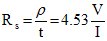 for t/s <= 0.5 (5)
which we refer to as sheet resistance.
However, the meter is just reporting a resistivity number and assigning it units of Ohms/square since it knows nothing of the material or boundary conditions that are being measured. So, the number on the meter could easily be interpreted as bulk resistivity.
Another way of saying it:
The meter is measuring the voltage across the two inside pins and then the operator’s guide says that the voltage is directly proportional to the surface resistivity. So what operation(s) is the meter software doing to the voltage measurement in order to report units in Ohms/square?
Given a measured value for Rho (which we could consider to be bulk resistivity) and a measured value for the thickness, t. I can solve the equation for the Voltage, V and use that as my metric for comparing the materials.
Does that sound correct?
A. In basic terms we are measuring a thin layer by supplying a current and measuring a voltage. The ohms/square button performs a purely mathematical function and so will not give an accurate result for the sample.
Sheet resistance = 4.5324 x V/I
Sheet resistance values are given as ohms/square. The ‘per square’ element is to differentiate them from other resistance values such as those for wires. Strictly the values are in ohms. When someone states ‘per square’ it is accepted that a thin layer is being measured.
Sample is 6.5mm x 1.6mm.
A correction factor is required and has been correctly stated as 0.2205.
Therefore he needs to use his current and voltage readings in the equation:
Sheet resistance = 4.5324 x V/I x 0.2205
He has rightly indicated that by using a 4.5324mA current he can simplify the equation to: Sheet resistance = V x 0.2205
He requires the resistivity of the ink and so, also as he has indicated, the ohms/square value should be multiplied by the thickness of the ink. He has indicated that he would do this by multiplying by the thickness in microns and therefore using units of ohm.microns for the resistivity. This is fine, although we are more used to working in ohm.cm!
I am then confused by the next statement:
“Rho=0.2205*V*t in units of Ohm*microns. I am seeing a difference in resistivity between several of the samples I am looking at. The approximate values I am measuring are between 0.160-0.275 Ohms/Square.”
He refers to resistivity but then gives some ohms/square values. I am not trying to be difficult here, but I wanted to try and work out what voltage readings were being taken and I am not sure how to reverse the equation as I am not sure whether the readings given are indeed resistivity (ohm.microns) or sheet resistance (ohms/square).
I hope this indicates that I understand what is going on, although I am further confused by Haldor Topsoe comments on ‘Thin and narrow’ samples pp. 58-59.
My only comments really are (in answer to the question asked):
1. These readings are only valid for measurements taken at the center of the sample – probe contact away from the centre could have a significant impact on measurement values
2. Variations in thickness could be shown by changes in values such as those shown, but I would expect the same sample to give the same values if repeatedly measured.
Thanks for the confirmation. I think the bit that was confusing… “The approximate values I am measuring are between 0.160-0.275 Ohms/Square” Those values were uncorrected readings taken directly from our meter. We are trying to work out the appropriate correction and you’ve helped us with the confirmation.
Q19B. Could I ask another question? We are measuring a trace (constant thickness assumed) that varies in width along its length. We’ve got a big wide pad connected to a long skinny trace connected to a skinnier pad. If we are measuring the big pad, is it fair to assume that those other skinny bits are not influencing the measurement? Or vice versa? Say we are measuring the skinny areas, would the big pad influence those readings?
A. I think it is fair to ignore the trace when measuring the large pad, and vice versa, assuming the trace measurements weren’t immediately adjacent to the pad.
Four-Point-Probes is a division of Bridge Technology. To request further information please call Bridge Technology at (480) 219-9007 or send e-mail to Joshua Bridge at: sales@bridgetec.com